Skip to content

What is Climate Change?

Climate Change refers to long-term shifts in temperatures and weather patterns. Such shifts can be natural, due to changes in the sun’s activity or large volcanic eruptions. But since the 1800s, human activities have been the main driver of climate change, primarily due to the burning of fossil fuels like coal, oil and gas. Burning these fuels generates greenhouse gas emissions that act like a blanket wrapped around the Earth, trapping the sun’s heat and raising temperatures.

The main greenhouse gases that are causing climate change include carbon dioxide and methane. These come from burning fossil fuels but clearing land and cutting down forests can also release carbon dioxide. Agriculture and oil and gas operations are major sources of methane emissions. Energy, industry, transport, buildings, agriculture and land use are among the main sectors causing greenhouse gases (UN.org).

Is Climate Change Real?

As we sit watching the rain steaming down our windows during our Irish ‘summer’ this can be valid thought. However climate change is less about the day-to-day changes in our weather and more about long-term trends in our climate, so think less about weekly or monthly temperatures and more about annual average temperatures.

2024 was the hottest year in global temperature records going back to 1850. According to the EU’s Copernicus, the global average temperature of 15.10°C was 0.12°C above 2023, the previous warmest year on record. This is equivalent to 1.60°C above an estimate of the 1850-1900 temperature designated to be the pre-industrial level and was marked 2024 as the first calendar year that has reached more than 1.5°C above the pre-industrial level.

 July 2024 was the warmest July on record for the globe in NOAA’s 175-year record and marked the 48th consecutive July with global temperatures, at least nominally, above the 20th-century average (NOAA).

We can also see the effects of Climate Change around us in nature as species change the timing of their reproduction, or species’ ranges expand or contract.

What does this mean for Ireland?

Ireland’s annual average temperature has increased by approximately 1°C over the last 100 years, with 16 of the 20 warmest years occurring since 1990, and 2023 being the hottest year on record. Extremes of heat in Ireland (heatwaves) are becoming more frequent and more severe, while extremes of cold (cold waves) are becoming less frequent and less severe. Heavy rainfall events have been 7% more intense over the last 30 years. Satellite observations indicate that the sea level around Ireland has risen by approximately 2-3 mm a year since the early 1990s (EPA Ireland’s State of the Environment Report 2024).

Overall Ireland’s climate is predicted to become more changeable and wetter, with more stormy weather, but with higher average annual temperatures. Projected Climate Change impacts for Ireland include impacts on biodiversity, with an increase in invasive species, competitive pressures on native species, and changes in species ranges and phenology.

Is Ireland a good place to study the effects of Climate Change on marine species?

Ireland lies on a marine bio-geographic boundary with cold temperate waters to the north and warm temperate waters to the south. This means that for some cold-water species Irish waters mark the southern-most boundary of their range, while for some warm-water species Irish waters represent the northern-most boundary of their range.

So we lie in an area of likely change in species range and phenology (the timing of life events such as reproduction) affected by climate change. By identifying and monitoring marine ‘bio-indicator’ species around our coastline we can see how climate change is affecting our coastal ecosystems and how rapidly change is occurring. We can also keep an eye out for newly arriving species on our shores.

What makes a good indicator species?

When we look at species distributions, those with restricted distributions around the Irish Coastline are good candidates for climate change bio-indicators. These could be warm-water species with distributions restricted to the south coasts, or cold-water species with distributions restricted to the north coasts. We also look for newly arriving species, usually warm-water species not previously recorded in Irish waters and species which show an unusual change in abundance – becoming much more common or more rare than they were previously.

Another good group for potential bio-indicators are those with distinct peaks in their occurrence, such as jellyfish. We can monitor these ‘peaks’ over time to see if they are changing with changes in average annual sea temperatures.

Example 1 - The Strawberry Anemone

The Strawberry Anemone (Actinia fragacea) is a larger cousin of the Beadlet Anemone (Actinia equina). Whereas the Beadlet Anemone is found at all levels on the shore, the Strawberry Anemone is found on the lower shore. It also grows to twice the size of the Beadlet Anemone, with its base measuring up to 10cm in width. The column of the Strawberry Anemone is covered in yellow-green spots while the column of the beadlet anemone is usually free of markings or may have linear rows of small dots running up the column.

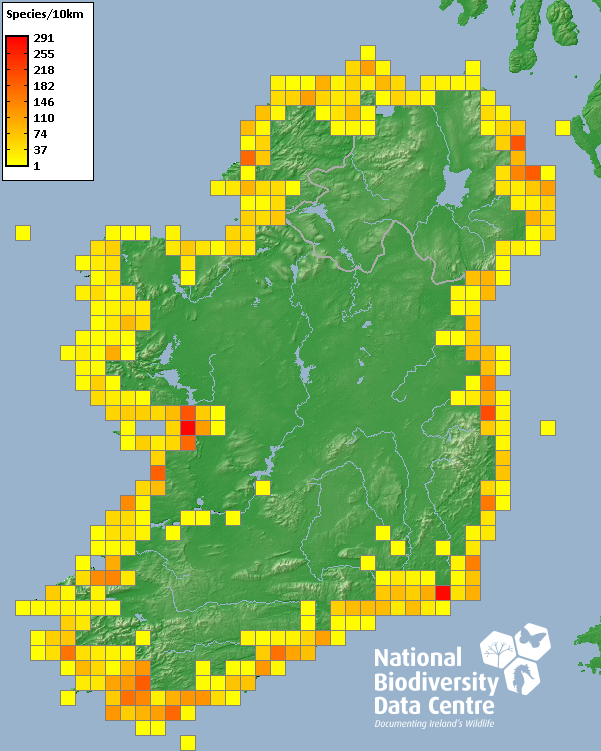
When we look at the distribution of Strawberry Anemone records from Explore Your Shore! we see that it is limited to the south and south-west coasts, indicating a species that prefers warmer waters. There are some older records of Strawberry Anemone further north but no recent records so on our to-do list is to revisit these locations to see if there are any Strawberry Anemones in those locations.

If you spot a Strawberry Anemone on the shore, please take a photo and submit your record to us at Explore Your Shore!


Example 2 - The Toothed Topshell

The Toothed Topshell (Phorcus lineatus) is a large topshell species with a distinct bump or ‘tooth’ prokecting into the shell opening, and distinct brown or purpke zig-zag patterns on the shell exterior. It is listed under the MarClim Study as a warm water indicator species.

When we look at the distribution of this species in the BioMar surveys (1993-1996) vs Explore Your Shore! (2019-2024) we can see an expansion in the species range along the east coast and perhaps northward (though BioMar did not cover the Northern Ireland coastline).

If you spot a Toothed Topshell on the shore, please take a photo and submit your record to us at Explore Your Shore!


Example 3 - Jellyfish Phenology

Some marine species have a distinct peak in their annual abundance around our coastline which may be detected through Citizen Science generated records. One example of this group are the jellyfish, and jellyfish-like creatures, which tend to have a peak month in which records are detected. By identifying this peak and observing it through time (over years) we may detect changes driven by climate change and/or other factors. This is termed Phenology, and is a well-used metric in studying climate change for terrestrial species (e.g. bird nesting, flowers blooming and adult dragonflies emerging). Here are a few examples from jellyfish, and jellyfish-like creatures found in Irish waters: